Showing posts with label Grand Prix. Show all posts

Thursday, January 10, 2013

Playing at Competitive REL – A Beginner's Guide


You've been playing at FNM's for a couple of months now, and you're starting to notice that you're winning more often than not. The same at your local shop's Tuesday standard.

You like your deck – no, actually, you love your deck. You built it yourself, and maybe it's not exactly a netdeck, but it has a solid game plan and you know how to pilot it against all the major decks in the format.

You're wondering if you should maybe take your game to the next level. You hear some guys at your shop talking about travel plans. You saunter over to them and ask them what they're talking about.

Oh, dude, you didn't know? This weekend is the Grand Prix.”

The Grand Prix?” you ask. You've heard some of the guys talk about how they went to Boston a few months ago, but you've never been to one. “What's that?”

It's a huge tournament – usually more than a thousand people – over two days. There's one this weekend in Atlantic City! A bunch of us from the shop are going down there.”

Wow, awesome.”

One more thing – it's a competitive tournament, a little bit different from an FNM.”

Oh?”

-----

It can be a little intimidating stepping into your first Competitive REL tournament. In fact, it can be downright terrifying. My first was a side event at Pro Tour Philadelphia (back when they were open to the public.) It was a big tournament for an iPad, and I got a game loss in my first game. Unfortunately, at the time, I had no idea that there was any difference between my local FNM and a tournament for $15,000. I assumed we were just playing Magic, and that was that.

The reality is a little different, and as a player who hates seeing people get screwed because they weren't aware of the difference, I'm going to be going into some detail about some of the things that you can expect at a Competitive event.

First off, what is Competitive REL? Because of the high prizes associated with them, some tournaments are run at a stricter level of rules enforcement than others. Notable events are the first day of a Grand Prix, TCGPlayer Max Events, Grand Prix Trials, Pro Tour Qualifiers, and Star City Games Opens, Invitational Qualifiers, and Invitationals

At these tournaments, there is some measure of high prizes at stake. It could be playmats, invites to other tournaments, byes, or large cash prizes. Regardless, because of the prizes being offered, the tournament is to be held in as skill-testing an environment as possible. That's where we hit the first major difference between Regular REL and Competitive REL.

During Regular REL tournaments, like FNM, the emphasis is on educating players. At Competitive REL, the emphasis is on an individual's play skill.

That might seem like a minor thing, but it really has a whole lot of implications. The most obvious way that you can see it is that at a Competitive REL tournament, there will be a judge who can hand out the penalties found in the Infraction Procedure Guide (or IPG, for short.) That's the document that all judges (and players, if they so choose) have access to, which tells about all the things that you can be penalized for at a Competitive tournament.

Some of these things are fairly simple. The IPG has a whole boatload of ways of saying simple things like “Don't Cheat”. Luckily, you're a good person, and you're not going to cheat. We don't have to worry about the vast majority of that section because it doesn't apply to you as long as you are being open and honest while playing.

That brings us to the first major rule that I'm going to give you if you've never played at Competitive REL. It's the first rule because I honestly believe that it is the most important.

Do not lie to the judge.

The judge does not exist to punish you. He exists to make sure that the game is being played by the rules, and to ensure an even playing field, and to make sure that everyone at the tournament is comfortable.

Sometimes, the judge will punish someone. That could very well mean anything from a verbal Caution (which means literally nothing as far as you playing the game goes) to a Disqualification (which is very bad.) For the record, receiving multiple instances of the same penalty does eventually lead to an upgrade in penalty to a more severe one. That said, lying to a tournament official is a one-way street to a disqualification. Period. End of Story. Just don't do it.

The IPG lists out a full treatment of everything you can get punished for. This is a good thing, because it means that judges can't just capriciously punish for anything, only things covered by the existing document. They can't 'go rogue' and just make things up. Please keep in mind that at larger events, you ALWAYS have the right to appeal a decision to the Head Judge of the tournament if you believe that your ruling was incorrect. For the majority of players in the majority of situations, none of that is important. In all my time playing competitively, I believe that I've received only a handful of warnings (and one game loss, as you'll see below).

How do you avoid such penalties? It's actually pretty simple. Play according to the rules, and be clear, open, and obvious about what you're doing. Below, I'm going to list what I consider to be the 5 most commonly given out errors and penalties, and how to avoid them:

-----

1) Tournament Error: Deck/Decklist Error

This one is the top of the list, and it isn't even close. In Round 2 of GP Boston-Worcester last year, over 100 of these were given out at the start of Round 4. This penalty refers to something fairly broad – there's a problem with your deck, or your decklist.

At Competitive REL, you will be responsible for filling out (either before the tournament begins for Constructed, or during deck constuction for a Limited Event) a deck list. Be very careful with this list, because as far as the tournament officials are concerned, that's what you're playing. In order to curb cheating and provide some measure of security for the integrity of the tournament, judges will be checking decks throughout the tournament. As long as what's in your deck matches what's on the sheet, there's likely to be no problem whatsoever. However, there's always a few things that can go wrong. Here's some of the common ways to earn yourself a Deck/Decklist Error:

-You made a last minute change to your deck, and forgot to update your decklist.
-You forgot to de-sideboard your deck after your last round
-You had a bunch of cards that aren't in your deck or sideboard in the same box as your deck and sideboard.
-You don't have at least 60 cards (or 40 for limited) in your main deck, and in Constructed tournaments, you have a number other than 0 or 15 in your sideboard.
-You are playing cards that aren't legal in the format that you are playing.

There are other ways to earn them, but those are what I'd consider the most common. The penalty for Deck/Decklist Error is usually a Game Loss – a steep penalty because the potential for abuse is so high. Be careful with this one, and when the judge tells everyone to take one last look over their decklists, I implore you to actually do it. Judges hate giving this one out, because it's usually so easily avoided.

My first infraction ever was a Deck/Decklist Problem. I didn't fill one out because I didn't know it was required. Whoops. By the time I was informed of this, round 1 was already well underway, and my opponent was happy to be cruising onto game 2.

2) Game Rule Violation

A Game Rule Violation is a general catchall category for an issue that takes place during the game, but doesn't fall into any of the other categories. Generally, it means that you did something that you shouldn't have done. At the moment, the most common one of these that comes to mind is putting a creature into the graveyard after it's been killed by a Pillar of Flame. There isn't much to say about this one except that you should make sure that you are doing your best to adhere to the text on cards.

3) Missed Trigger

Everyone take a deep breath, because I know that you've heard tons about this one. You've heard things about lapsing and nonlapsing triggers. You've heard tons about people getting disqualified for ignoring triggers, and abilities that don't happen when they should.

Relax. Take a deep breath. This one isn't that tricky.

First off, some info, and the largest change between Regular and Competitive REL. At Competitive REL, you are required to demonstrate awareness of each one of your triggers. If you (or your opponent) do not, then the trigger is considered missed, and a judge should be called.

Full stop.

When a judge is called, a couple of things will happen. First, the judge will establish if the trigger was actually missed. A trigger is considered missed if the player who's trigger it was has taken an action after the trigger would have resolved without indicating that they were aware of the trigger. Second, the judge will ask the opponent of the player if they would like to place the ability on the stack. (The answer will generally be no. Do I want my opponent to gain 2 life and a 2/2 wolf token – no, no I do not.) As far as the game goes, that's the end of it.

Then, based on if the ability is detrimental to the player, they may get a warning, but that's not generally something that players will need to worry about.

The penalty for a missed trigger is usually nothing, but is occasionally a Warning, however, you likely won't get your trigger unless it hurts you in some way. Failing to activate a trigger deliberately and pretending you missed it, by the way, is cheating, so don't do that.

If you have any more questions about missed triggers, I strongly suggest you read Level 5 Judge Toby Elliot's Blog on the Topic. It can be found HERE. There is additional commentary HERE as well.

4) Looking At Extra Cards

This one is actually remarkably common. Have you ever been shuffling your opponent's deck and accidentally spilled it all over the table? You looked at some extra cards. Ever try to draw a card and the top one flipped over onto the table? Looking at extra cards.

It generally takes place whenever someone looks at (but doesn't draw!) extra cards.

To avoid this one, just simply be deliberate with your actions. Be sure you've only picked up one card. Shuffle gently (but thoroughly!) with your opponent's deck. Doing this is a Warning.

5) Drawing Extra Cards

On the other hand, if instead of just looking at extra cards, you actually draw extra cards into your hand (indicated by the cards making contact with the rest of your hand) we've entered into a different penalty altogether. Drawing Extra Cards is one of the most extreme infractions that can be committed, because of how much potential for abuse there is, and how little an opponent could potentially do to stop it. Worse, because there's no easy fix, drawing extra cards is almost always a Game Loss.

There are some exceptions that you could look up, but those are extreme corner cases, and it's best to just simply be extra careful any time that you're drawing cards – this goes for drawing for turn, drawing dozens of cards in a single turn off a Glimpse of Nature, or casting a Sphinx's Revelation for a whole bunch. Count the cards before putting them into your hand, and we won't have an issue.

-----

There are a number of other infractions that can be given out for a variety of things, the vast majority won't actually apply in almost any situation. If you want to take a look at the entire list, the entire IPG is available for your perusal HERE.

I'd also like to point to a pair of articles that Jackie Lee, a notable professional player, has written on the topic of Competitive REL and Judges – Here and Here. They are both well-written, well-informed articles that I recommend to anyone looking to break into the competitive scene.

I want to take a couple of paragraphs at the end of this article to ease some concerns as well. If you're looking into starting at a Competitive tournament, you should consider the judge an ally. We exist to help you at all times, and make sure that the tournament is a fun experience for all. If someone at the venue, even another player or tournament official, is giving you a problem, please, speak to a judge about it. Likewise, if you are unsure of an interaction, or you think something has gone wrong in your game, call a judge. They will be more than happy to help you sort it out.

If, at any point, in any tournament, you ever need the assistance of a Judge, just raise your hand high (some of us have trouble seeing through all the spell-slinging, so clearer is better), and yell loudly “Judge!” One of us black-shirted folks will be by shortly to sort things out.

With that, may all your spells resolve, and good luck at any future events you take part in.


Tuesday, January 8, 2013

Back In The Saddle - Esper Tokens for GP Atlantic City


It's been a while since I've addressed Standard in one of my blogs, and this upcoming weekend seems to provide me with the perfect time to talk about it. Since becoming a judge, my opportunities to play competitive magic have declined pretty significantly. It's not that I enjoy it less, it's just that opportunities to judge seem to keep cropping up, and I have only so many weekends that I can fill with Magic. Couple that with the holidays, and I haven't been at a Competitive REL tournament since November – and that wasn't even Standard. (It was a Legacy Tournament – which I am happy to report I Top 8'd, with much the same BW list that I've been running for some time now.)


Since the last time I'd checked in, Standard has changed a bunch. The last couple of FNM's that I'd gone to had been decidedly during the era of Jund. It was everywhere, and I was of the opinion that my former tokens list couldn't compete on the same level as it. Something needed to be done.

Luckily for me, the format shifted, then shifted again. Despite not playing, I still followed the scene, checking in with some of my favorite authors and noting the results from Star City Opens and GP's. I have to say, from the look of things, it seems dynamic and interesting, but I still can't quite muster the same level of enthusiasm that I had during the Scars-Innistrad Standard. Perhaps having a 'bad guy' in the format spurs me on to more deck building than normal. Maybe the relatively small subset of cards that sees play in every deck is irking me. I hadn't been able to really pinpoint what it was until recently.

When I sat down to write my New Years Resolutions, I came to the conclusion that I wanted to have a couple dedicated to Magic. I'd slacked off on quite a few projects – my Shard War decks, Illyria, and I'd been sitting on my hands regarding advancing as a judge. Most of all, I didn't have any decks (except my Legacy deck) that I really wanted to play all that much. I vowed to change that before the end of the year.

For those who have been reading this blog for the last few months, you know that I fell in love with BW Tokens, lovingly updating it week by week, and having a reasonable amount of success with it. I felt like I understood the deck on a fundamental level, and all it's match-ups. Unfortunately, the rotation was not kind to my poor spirit tokens.

People had been telling me for months before the rotation that the deck was strong, but would be much better once Ratchet Bomb and Elesh Norn were gone. Interestingly, none of those people kept saying it after Detention Sphere was printed, and that was only the start of the issue. Olivia becoming highly played provided a roadblock. Still, I could fight through those things. After all, the titans were gone, and the caliber of board wipe that remained in standard was a far cry from Ratchet Bomb and Sun Titan.

That said, Tokens was not without casualties. Specifically, two of our hardest hitting cards went by the wayside. Hero of Bladehold and Honor of the Pure both provided huge offensive boosts to my squad that were proving difficult to replace without serious reworks to the deck.


The inspiration for the update actually came from my friend (and deck building prodigy) Marshall. He'd been working on a Spirits tribal list for a while (and was actually working on a list extremely similar to John Finkel's Pro Tour Honolulu list as Finkel was winning with it). After the success of the deck, it was poorly positioned for a while, with the whole format devolving into creature mirrors between R/G, Naya, Pod decks, and Angel Delver. It also had some issues with an unstable mana base if you tried to add the black splash for Lingering Souls. With the rotation, Marshall felt it was time to give it another shot.

The addition of Hallowed Fountain did wonders for the land base, allowing him to cut into a third color for more than just a narrow splash. After seeing his list, utilizing Drogskol Captain, I realized that it had a remarkable resemblance to my tokens list, and decided to modify it:

As usual, I began with an existing deck. A lot of my card choices seem to mirror the briefly seen Esper Flash lists that were thrown around for a week or two. I'd played the Esper lists (as well as the UWr version) casually for a couple of test games before dismissing them. I didn't like how many turns I was spending just cycling through cards, and I didn't like how low my threat density was. With a the core of the tokens deck still intact (Midnight Haunting + Lingering Souls + Intangible Virtue), I felt that there was definitely a deck still there, and I searched for a way to intensify that.

In the meantime, on the back burner, I had a playset of Restoration Angels that I love fiercely. I wanted them to see more play, I just needed a deck to slot them into.

Once I decided to add blue to the deck in earnest, the question became “What can I gain?” Snapcaster seemed an obvious choice, but in testing, I found that the deck was already mana-hungry enough, and didn't often produce too many good targets for the Wizard. I cut down to two copies from four. Augur of Bolas, despite the occasional flub, served as a much better two drop for my Flash Tokens. Plus, it provided a great body to flicker with Restoration Angel. The breakthrough came later, with Favorable winds providing the redundant anthems that I'd always wanted.

Once I had favorable winds, all the formerly aggressive draws were out. I didn't want to lead Champion of the Parish into Gather the Townsfolk. There was too much spot removal in the format, and I couldn't follow it up as strongly without Honor of the Pure to provide consistency. On the other hand, I did have a powerful engine that allowed my flyers – token or not – to trump similar plays by other decks. My Restoration Angels could block (and kill!) opposing ones, and with spot removal on the rise, my swarms had never been more effective. Once I'd decided on the flyer emphasis, it naturally brought my curve a little higher – towards the 4 and 5 mana range. Geist Honored Monk started seeming like a great creature to play – with Restoration Angel being able to hit it for added value. A few counters, and a smattering of removal spells (or at least, what I could find given the color constraints) rounded out the list.

The final card was a single copy of Sorin, Lord of Innistrad. He was too slow for my previous list, but here, he seems just right. All of his abilities are relevant, and he comes at a point in the game when each could be the correct thing to do. I'm considering adding a second if I can get a hand on one.

The end result (sans sideboard) is this:


The deck has one main issue, right now: the insanely aggressive decks. Not the midrange-y zombies lists, which tries to kill you with 4 and 5 drops. Those we can deploy a wall of Spirits to block effectively. I'm talking more in the terms of Naya Humans, Mono-red, and things in that vein. Thalia still provides a major roadblock for the deck – serving to give a one sided cost bump to almost literally every card in the deck. I'm still working on a solution to some of those, but I'm confident in my ability to work it out in time for this weekend. While I don't love it the way I loved BW Tokens, it's at least a deck that I can feel comfortable playing for a long day. I've already got a room at Atlantic City with two of my good friends, as well as my girlfriend, and I'm planning on seeing if I can grind my way through 9 rounds to a 7-2 record, and a berth in Day 2.

What do you think about my list? Do you see any glaring omissions in it? Anything that you think could be improved, or significantly changed for the better? Feel free to leave a comment. Going to be at Grand Prix Atlantic City? Drop me a line if you want to catch up. I'm more than happy to chat with anyone.

May all your (and my) spells resolve.


Tuesday, August 14, 2012

Bye Bye Bye - Why Planeswalker Points Are Important

Hey man! I haven't seen you around here in ages.
Yea, I've been pretty busy traveling.
So, you coming to Sunday drafts now?
Absolutely. I’m grinding for points. Didn’t you hear? There’s a GP in Philadelphia in October. Got to be ready.

-----

As some of you may know, this coming Sunday represents the end of the second Planeswalker Points season. For some of us, that makes this week a flurry of furious playing and grinding, with the hopes of gathering those last few points. For others, the entire idea of planeswalker points seems alien and obtuse.

Why are we seeking planeswalker points like they’re some finite resource? Why do some of us keep track of the number with post-its and bookmark the page in our browser to make sure that everything is up to date?

There’s a couple reasons for it, honestly, and to start, I’d like to tell you my story.

A few months ago, I decided that I was interested in joining the Magic Competitive Scene. Previously, this meant going to GP’s and PTQ’s, hoping to qualify and make it to the Pro Tour. Unfortunately, my level of skill at that point was nowhere near where it would need to be to have a chance at either of those events. I wasn’t thinking clearly about what I’d need to do to succeed. I was flush with success with a Top 8 at a 75 person GPT, and I thought I was one of the best players ever. Seriously. I actually thought that.

Unfortunately, I didn’t really have anything to work towards. There weren’t any GP’s in the area, so I just shrugged it  off and kept playing in GPT’s and SCG:IQ’s. The story could have ended here.

Then there was an announcement. A special tournament – held three places across America. The World Magic Cup Qualifier. All jokes about qualifying for a qualifier aside, I knew that this was an event I wanted to participate in – and it was fairly local: just past Baltimore, maybe a two hour drive. I checked the requirements and found that I needed 300 Planeswalker Points to get an invitation.

I fired up the handy website and took a look. The system is pretty simple – three points for a win, one for a draw, none for a loss, and then multiplied by the kind of event it was.

FNM – 7 points
FNM – 4 points
FNM – 7 points

This looked like it was going to take a while.

GPT Baltimore – 66 points.

Wait, what? Sixty six? Well, I suppose that the event was seven rounds of Swiss, where I went 6-1, and you get some points for participation…

 If you’re looking to grind points, events with a multiplier are where it’s at. There’s just no competition. You could win 9 rounds of FNM, and it’s likely worth less than winning three at a GPT – or just a little bit more than two at a PTQ. A single win at a GP is worth more than two flawless Friday victories at your local game shop.

But why do we want these points? Even ignoring the primal urge – present in every nerd – to make numbers go upwards. (Seriously, take a look at every RPG ever. That’s all we’re doing) Surely there are rewards for earning all these points! Well, luckily for us, there are – and the rewards are significant. Let’s take a look at some of the numbers to know for the current system.

-----

Byes:
By gaining planeswalker points in the current system, you can earn Byes at Grand Prix events. A bye is a free win in one of the early rounds, and any player can have up to three. Having them is an enormous advantage, and for many, these are the primary benefit of Planeswalker Points. These points accrue over the course of a season. The most recent season ran from April 2, 2012 – August 19, 2012. The next season, which begins on Monday, runs from August 20, 2012 – December 16, 2012. If you earn byes during a season, they will apply for the duration of that season and for the next one as well.
                -One Bye: 400 points
                -Two Byes: 750 points
                -Three Byes: 1500 points

Invitation to the World Magic Cup Qualifier:
 Where Grand Prix Byes count based on a single season, the World Magic Cup Qualifier tracks points over an entire year. The most recent World Magic Cup Qualifier season began on April 2, 2012, and will end on March 17, 2013. To be invited, you need to reach a threshold based on your country. These range from the USA – where you’d need 500 points within the year, to small countries like Peru, where the cutoff is a mere 100 points. You can find the list of thresholds HERE.

-----
For those of you wondering if a Bye is even worth anything to you, it’s a fairly simple question. If you are going to a GP, the bye is absolutely worth it. Compared to the FNM’s and other events that you’ve gone to, GP’s can be more likened to a marathon. With two days of play and thousands of dollars of prize on the line, you need to be at your best to have a chance, and that means giving yourself advantages before you walk in the door.

A normal GP plays 9 rounds on Day 1. To advance, you need to be 7-2 or better. Going 7-2 in a tournament is no mean feat, and even a single bad mulligan could spell the end of your tournament aspirations. With three byes under your belt, you mitigate that to a paltry 4-2 to make the second day of play (and put yourself in contention for a reasonable cash payout!) In addition, the three byes have the related side effect of making your tiebreakers markedly higher than those without byes. Because people playing since round one will have their tie breaks calculated off all their opponents, they account for the person who started off 0-1, 1-1, and 2-1. Your worst tiebreaker player is the person you hit in the fourth match, who (assuming you win) will be 3-1 at that point. This could buy you the crucial percentage points that elevate you into the “I won something!” arena.

This coming season, for example, I’m planning on attending two GP’s – one in Boston, and one in Philadelphia. Each Bye I earn puts me that much closer to Day 2. Because I played in GP Atlanta, as well as a number of other events, I’ve earned over 900 points, easily enough for my second bye, but still a far cry away from my third. With the addition of a second GP to my personal schedule in this coming season, it would be a reasonable thing for me to expect getting a third bye in the coming season. As my play gets more precise, I expect to earn more points for any given tournament. GP Atlanta earned me a cool 200 points, and I didn’t even make Day 2. If I had, it easily could have been a 350-400 point weekend.  I certainly wouldn’t have been as close as I was if not for the three byes I had.

This is more or less how GP Atlanta felt with three free wins..

This coming season, I’d encourage you to set yourself a goal – be it your first bye, in case you attend a GP early next year (the schedule should be announced soon!) or qualification for the World Magic Cup Qualifiers, or whatever you decide. Set yourself a goal, and then set out to attain it!

[Editor's Note: The Planeswalker Point website can be found HERE.]

-----
I hope that you guys enjoyed this look at the planeswalker point system, and what we can get out of it as a competitive player. Next post comes in Thursday, where I’ll talk a little bit about what I see in the format going forward.

Thursday, August 2, 2012

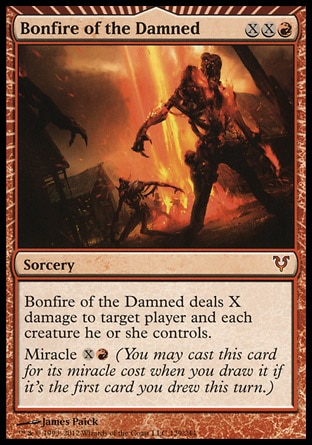
Beat em or Join Em?: The Problem With Bonfire

Format Warping

There, I said it. I’ve played in quite a few tournaments since the release of Avacyn Restored, and one thing has started to become more and more clear over the last few days. Bonfire of the Damned is – and is going to - warp the format.

When Miracles first came out, many Magic writers took their fingers to keyboard and decided to write a bit about the issues with Miracle. What were they trying to do? What does the mechanic accomplish? Is the mechanic any good in reality?

Well, we have our answer. With the price of Bonfires reaching $35 at most online vendors and rising steadily, it looks like we’re going to be living in a world where Bonfire is the shadow looming large over the whole format. Whenever a player has Red in their deck, I cringe every time that their hand touches their deck for the draw. The primer for the Hallelujah deck that won the Pro Tour said it best – you need to play up your draws, make the opponent tilt every single time you touch your deck.

When I’ve got six 2/2 tokens in play, there are no safe top decks anymore if you have a mountain.

The word 'Boom' comes to mind.
 
I wasn’t sure how good it was myself. I kept playing BW Tokens, and I was shocked when my matchup against GR, which had previously been fairly close (if they didn’t blow me out with a Sword) was all of a sudden turned around by a crippling Bonfire at any stage of the game. I feel like you’d need to be playing 12 anthems to have a chance of ‘outrunning’ it. Naya, running Restoration Angel and Thalia, doesn’t even feel close. They just stone-wall me at every turn, keep me from casting anything of consequence, and crush me with a vastly superior creature base.

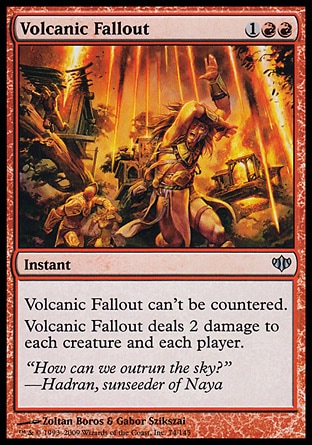
 I still didn’t believe it though. I kept playing events with BW Tokens, and every time someone cast Bonfire, I lost. It seemed normal though – it seemed fair. Lights didn’t go on in my head until my girlfriend and I were sorting through some Alara Block commons and uncommon (I’m working on the Shard Wars, and while she doesn’t play the game, she seems to really enjoy the art.) I was flipping through the Conflux section and I pulled out a card, instantly knowing the story behind it.


I'd be Bitterblossem if this was printed too.
 
“Oh hun, check this card out.”
“I like the movement in the picture. And the quote is pretty awesome too.”
“This card changed tournament magic. Remember that Faerie deck that I was telling you about?”
“Yea?”
“This card single handedly turned the tide on it. Once this card was printed, Faeries wasn’t the bad guy of the format anymore. It was to tailor built to kill Faeries that they just couldn’t compete.”
“That’s evolution for you.”

And then I stopped. I remembered every time I saw Bonfire get a four for one, or a six for one. I remembered seeing a field of creatures – twice lethal damage – during testing on Tuesday. I peeled the Bonfire, set X = 5, and killed him that turn from 20. The game wasn’t close – and then he lost it.

Let's be honest though. Cards warp formats all the time. Snapcaster has turned Unsummon from an unplayable card into a format staple. Jace caused Hero of Bladehold to be an actively terrible creature. The Eldrazi have made mill nonviable in EDH without bending over backwards to do it. That doesn't mean that we should call for bans, or complain. That means that it's time to innovate and figure out a solution to the problem. We have two choices here - we can either join the Bonfire crew (as I have at the moment with Naya) or fight against it (as I'm trying to do.) 

When that can happen, and you need to account for a one sided wrath of god for 3-4 mana, it’s going to change a format pretty significantly. You need to be on one of two sides in this format – for it or against it.

For Bonfire:
There’s a whole slew of decks that you can use to battle with Bonfire. There’s Naya in all its variations, R/G Aggro, we’ve got UR Delver, and even some zombie variants have the capability of running it. In the end, any deck with a reasonable board presence can and should run the card.

Reasonable board presence? Yes. Because if you’re not a deck that can capitalize on the “All your creatures are dead, but mine aren’t!” angle, you’d be better off with Slagstorm or Pyroclasm. Bonfire works very specifically when the effect is also a Falter for your whole team. This means that it’s best as the primary removal spell in an otherwise aggressive deck. Simple enough.

You should play Bonfire in any deck like this, because it’s frankly the highest impact card available for use. It does so much for it’s cost – even at standard cost, it’s just a slightly weaker, but more Flexible Flame Wave. That sounds like a reasonable card to me, and Bonfire is actually just better than that.

All hope is not lost for the rest of us though! There are options to be had if you don’t have the money to invest in cards that are more expensive than some fat packs.

Against Bonfire:
It seems like only yesterday that we were all trying to figure out a deck that could defeat Delver consistently, and rid us of the menace that was Delver, Mana Leak, Vapor Snag, and Snapcaster Mage. Fortunately, they appear to be on the decline, but it’s still a very reasonable deck. There are two main things that the deck does very well that allow it to combat Bonfire – a pro-active way and a reactive way.

Pro actively, Delver is able to deal a lot of damage with few cards. When your 1-drop is capable of being a lightning bolt every turn, you don’t generally need to overextend into the board to find your victory. Delver is very capable of killing you using only 2-3 cards, and using the rest as support. This minimizes the ability of the deck to expose itself to a Bonfire.

On the other hand, Delver has reactive answers to Bonfire. Restoration Angel, allows you to keep the offence going if a Bonfire does happen – letting you sneak a creature in ‘with haste’. Alternatively, you could use a mana leak/dissipate to remove the offending spell from contention. Bonfire is a fairly mana intensive spell, and with positive benefit for each added mana you use, so there’s a pretty decent chance that he’ll run it into your leak pretty hard.

The other option is a Ramp deck. Creatures scale upwards in toughness with mana cost – generally. You’re more likely to get a substantial body on a 6-7 mana creature than on a 2 mana guy. It seems obvious, but if you jump the curve with mana dorks or actual Ramp spells, then you’ll often be able to ‘outrun’ the Bonfire’s kill range. A turn 4 titan is way too fast for a bonfire player to deal with – by the time that he’s got 7 mana available, and can even potentially draw a Bonfire to kill it, the game is likely over. Elesh Norn fits into a similar area here, where her toughness makes her mostly-bonfire-proof. You also get the benefit of playing individual creatures that can win the game on their own.

In conclusion, the best ways to fight bonfire are the ways we’ve traditionally fought good sweepers – be bigger than them, be faster than them, or be able to stop them from casting it. Regardless, don’t you dare walk into a tournament right now without a plan, or you’ll end up on the receiving end of “Miracle Bonfire, X = 4, swing for lethal?”

It happens more than you’d think. This wekeend is Magic Game Day, and there will almost certainly be Bonfires in the room. Don't go in unprepared. Know your formats, sling some spells, come out on top.

-----
This weekend, I'll be at SCG: Washington DC on Saturday, spellslinging in the Standard Open. I don't have terribly high hopes for this tournament, but I'll be in the area, and it seems a waste to be in the city without participating. I've yet to decide what I'll actually be playing. It'll depend a lot on how I feel about the Naya mana base tomorrow, or if I'd rather just innovate BW Tokens to fight it. I'm hedging at the moment.

Tuesday, July 3, 2012

Tournament Report: GP Atlanta (6-2-1)

It’s different when you know that it’s your fault.

“You’re going to do great,” my girlfriend told me as I kissed her goodbye at the airport. “You’ve got Marshall’s deck, and you know your stuff. You’ll be fine. See you on Sunday.”

My flight took off on time. The ground was thirty-something thousand feet below us, and I was there on the flight, trying to nap, tapping a pen gently against the notepad with my decklist scrawled against it.

“Cut a land?” I mused. “No, Flood over screw. Maybe cut one for Mishra’s? This Vault of the Archangel seems terrible. It’s a five-mana land in legacy.” I looked back up at the creatures. “Bone Shredder? Six mana for a 1/1 is so bad. I don’t know what Marshall was thinking. It answers Show and Tell if they go for Emrakul, but it’s useless against Progenitus and Griselbrand.”

I was nervous. Even though I had three free wins, I still needed to go 4-2 in played rounds to make day 2. My preparations were bad, by any account. Three rounds on Magic Workstation – two against stifle-naught and one against affinity. I was 1-2 in those. I split games against Pop in testing with Junk, but he decided not to play the deck, going with Maverick instead.

Was I bringing a pistol to a gun fight? There was a reasonable chance. I’d hate to go 0-2 drop after flying down to Atlanta, but would that be the worst case?

We land, and I grab dinner at a bar next to Pop’s gate while I wait for him. It’s absolutely delicious. Peppercorn chicken quesadillas and a local homebrew beer: Sweetwater 420.  If you get the chance, I strongly recommend Sweetwater beers – at least in Atlanta.

Pop arrives, and we make for the hotel. The place is marvelous – and I mean that literally. The hotel is a giant hollow rectangle with a central column containing the glass elevators. The end result is a cavernous hotel that appears to go on forever. The golden glow from the interior lighting feels warm and accommodating.


Pop and I are both tired, so we hang out in the room while I sleeve up my deck. I’m still not sure if I’m playing the 75 that Marshall gave me, or if I’m switching things around. By 11pm, I’m in bed and I’ll figure it out in the morning.

---

We’ve registered, and I went with Marshall’s 75, unchanged. At least that way, I’ve got a safety valve if all the cards are terrible. (Sorry Marshall!) There are 905 people competing in the main event, which means 9 rounds. The judge informs us that X-2-1 or X-3 might even make the split, depending on how things go during the tournament. That makes me feel pretty good about my chances.

I wander around the hall, periodically checking in with Pop over the first three rounds. He ends up at a 2-1 split, narrowly losing to Dredge despite an otherwise reasonable matchup. I still think he wants a second Bojuka Bog. Come to think of it, I probably want a Bog or two, at least in my sideboard. Too bad that I’ve already turned in my decklist.

The fourth round is called, and I walk to my round – about to play my first game of Legacy at Competitive REL.

Round 4 – Andrew Bailey on RUG Delver
Andrew gets a slow start off the bat, playing a more defensive game. I’ve watched a ton of Legacy over the last few months, so RUG is a deck that I am very familiar with. I get a Vial out past his Dazes and Spell Pierces, and use it to flash in two Serra Avengers. For his part, he’s cast a Tarmagoyf and a Nimble Mongoose and started swinging. I drop some health, then start coming in with the pair of Angels backed up with Vault of the Archangel. With my health jumping up by six each turn, he scooped as soon as I played a Mother of Runes.

Game two goes less well. I mulligan to six and keep a hand with Karakas and two swamps, and his first Wasteland locks me off white. I die a death to Insectile aberration with five removal spells in hand, all requiring W.

Game three I also have to mulligan to six due to land concerns. (Two hymn to tourach and no black sources makes for a horrible hand.) But I find a Vial, Mom, Plains, Swamp, Thalia and Mirran Crusader. That seems good enough to me. After drawing into an inquisition the hand goes insane and I carve him up, never dropping below 17.

4-0 (2-1 in games)

Round 5 – Dustin Flora on UR Delver
I’ve never even heard of this deck, except that Pop lost to it the previous round. I assume that it works similarly to the standard version, and just tries to go for the throat as quickly as possible. Round one starts with him on a Goblin Guide who flips four lands for me. I’m not sure if that’s a good thing or not.

We go back and forth for a while, with me having a Batterskull live and him pulling together some ground forces – hoping that his pair of Delvers flips and makes it a race. We’re both on 12 life. I play too conservatively by trying to play and equip a Jitte over two turns, and he gets the flip, barely able to get me by blocking the Jitte-equipped Batterskull and suiciding his Lavamancer with his last two  cards in graveyard (after he topdecks a fetch land to enable it).

After the match, at my request, he told me that I’d misplayed a bunch of turns earlier by not equipping my Stoneforge Mystic with Batterskull, rather than bounce-replaying it. I told him I was watching for a bolt, but he shook his head and explained that I’d seen his only card at that point, and it was a land. I need to get better at actually using the knowledge of their hand that I have.

Game two is a blowout. He has Sulfuric Vortex and Sulfur Elemental that gets two Moms and a Thalia. The game didn’t go much past that.

4-1 (2-3 in games)

Round 6 – Pascal Maynard on RUG Delver
Pascal sits down for our match and I say hello. We have a little trouble communicating because he’s from Canada and has a pretty thick accent (I’m sure he felt the same about me.) Nevertheless, he puts headphones on and starts to shuffle.

Now, I’m not that guy to ask you to take them off. If that’s how you’re comfortable playing, that’s alright, but it always rubs me the wrong way to be playing against someone who thinks his music is more important than communicating with his opponent. He may be a perfectly nice guy, but wearing headphones makes me think he’s a bit of an ass at the time.

Game one stalls out with both of us high on life until I drop a near-instant speed Batterskull. (Vial EOT > Mystic > Batterskull on his turn.) He may have been able to fight out of that, but when I vial in Mangara with a Karakas in play, he knows he’s done for. That lock is extremely powerful, and I’m glad I was able to pull it off at least once this weekend.

Game two he comes out of the gate aggressively, but I’m able to finally get a Jitte on a Mirran Crusader and wipe his board. He tries to come back and finish me from 5 life, but with Jitte Counters protecting me, I’m able to kill him past his Goyf and cards in hand.

5-1 (4-3 in games)

A judge walks over to take our slip, he looks at it and goes "Oh, which one of you is Andrew?" I raise my hand. Turns out that he read the article that I wrote on the WMCQ, and enjoyed it. So, woot. My amount of real-world people noticing me is rising, which inflates my ego more than is healthy for me.

On to a round that went less well!

Round 7 – Joe Rittiner on Counter Top
I know that this deck exists. That is about all that I could tell you about it, and that it assumedly contains some kind of counterspells and a Sensei’s Divining Top – or some other interaction with the top of something.

I’ll be brief, I don’t have a shot either game. I throw a bunch of spells into counters early in game one because I keep thinking that he can’t possibly have another. By the time I find a vial, the game is already locked up and I scoop.

I start game two with an awesome hand – two vials, and plenty of gas. I figure that bypassing his counter wall should give me a good chance of getting in for…

“Land, Pithing Needle on Vial.”

He had Counter-Top by turn 3. He Entreated the Angels twice. I didn’t win this round.

5-2 (4-5 in games)

Being 5-2 feels much less alright than being 5-1. All of a sudden, I’m fighting for my life in the tournament. There’s two rounds left, and I need to win both of them to make Day 2. Going into this tournament, I’d told myself that Day 2 means the whole thing was an unmitigated success. Making Day 2 of your first GP  is a great accomplishment, and I was aiming for it. Just two rounds left.

Round 8 – Bryan Elliot on Junk Control
Bryan’s deck is interesting. He’s running all kinds of Discard as well as a Stoneforge Package, but he’s also missing any other kind of threats. Despite carving my hand up with Thoughtseizes, I’m able to beat him on board presence in a slow grindy game that wasn’t as close as it looked.

In game two, he mulligans, and while he’s reshuffling, I look over at the game next to us. Both players are laughing hysterically and pointing at the field. The result? Both players are mono-mountains, with a pair of Pyrostatic Pillars and a pair of Sulfuric Vortexes in play.

“Jesus…” someone whispers. “You guys aren’t gonna be casting many spells, are you?”

Back to my game. I keep a loose seven with no white source, but two AEther Vial. He thoughtseizes me and takes one, but the other resolves. He seems very tired, and is almost lazily drawing his cards, and probably not playing ideally under any circumstances.  We go back and forth for a while, but eventually, I equip a Manriki-Gusari to Thalia and start to kill off his equipment (a Jitte and a Batterskull). He’s bringing them back with Academy Ruins, but he can’t possibly keep up without his draw step. I kill him in another long grindy game.

6-2 (6-5 in games)

After the match, Pop comments that I was playing kind of tilt-y. I missed a few on-board things, and was tapping a Marsh Flats for mana. It was a legal play because of Urborg, but he had a feeling that I wasn’t intending to do that, so he wanted to mention it to me. I try to get my head back in the game. Only one round to go, but it’s after 9pm now, and so that proves a little difficult.

Round 9 – He Who Will Not Be Named with Elves
 A word on this round before I begin. Despite giving the names of all the other people I played against in all the previous rounds, I’ve decided to omit his name from this one, because while I think he was an ass, I’m not a fan of public shaming.

The first game goes quickly. I swords his Symbiote early to stop him from going off as effectively, and he scoops as soon as I get a Jitte Equipped to Mirran Crusader.

The second game goes much longer. I look like I have control, swinging for 3 per turn with a Jitte equipped on 2 counters. He doesn’t seem to have much, then, almost out of nowhere, he goes off. I’m hoping that I can get out of it with a well timed vial for the last two points that I’ll need, but when he Living Wishes for an Emrakul, I know I’m pretty much done and I pack it in.

I mulligan to six in game three, which already has me feeling horrible. He gets a quick start, but not on his combo plan. A Hymn and some other discard takes him down to just a Verdant Catacombs in hand, and he topdecks a Joraga Warcaller, giving all his elves +2/+2. He starts to beat me down, getting me to 6 before the board stalls out. We’re both topdecking, me using discard aggressively to keep him  away from increasing his board presence.

Before I go into this, I’d like to point out that we’re both playing very quickly because there’s less than five minutes in the match. A draw gets neither of us into the Top 8, so we both want to finish the match. We’ve been pretty friendly up till this point.

I vial in a Stoneforge Mystic on his end step and touch my lands to untap, reach for my deck.

“You missed your trigger.”

Ladies and gentleman, tilt mode engage.

After talking to judges later, I think it would have been possible for me to have called them and gotten it ruled as out of order sequencing, or a player communication error, or something on those lines. If that happens, I win the game as soon as I attack, because I can trade one of my creatures for three of his, and keep Jitte on the field. He would have no hand, and the game is over. I’m gone enough that I don’t call the judge to try and get the trigger and we keep playing/

Over the next five turns, his demeanor changes from polite and friendly to aggressive and curt. He asks me what my play is three times over four turns – despite the complex board state. Due to a zealous persecution in hand, I have lethal in hand if I can manage to clear his Joraga Warcaller and then Persecute him to wipe his board. As I’m writing this, I realize exactly how bad my tilt is because I never did that on his end step.

I missed two Dark Confidant triggers, and get a pair of warnings from the judge. My opponent is pushing me to play quicker, and I’m getting sloppier by the second. He’s clearly trying to make me screw up so he can get the win. I’ve got control of the game, and with five more minutes, I could have won handily. Without misplays, I likely already would have. As is, I’ve still got significant control of the board. He has three forests, a symbiote, and a pair of mana dorks, plus no hand, and the Warcaller on 2.

Time is called, and we draw. He doesn’t extend the hand, but crosses his hands on his chest and frowns. “Well, one of us could concede. I think I have better tiebreaks. Will you concede to me?”

“I will not,” I respond. I was winning the third game at time, and this is my first GP. He’s already top 8’d a few of them, and top 16’d a couple more. This is old hat for him. Frankly, this means more to me than him. “Will you concede to me?”

“Absolutely not.” He packs up his cards, signs the slip without another word, and walks away.

6-2-1 (7-6-1 in games)
Final Ranking: 140th of 905. 129 advanced at 7-2 or better.
I would have made it if I had won that last round.

For those who know him, Pop’s ending record was 5-4

I think it was rude of him to ask for the concession there. If the match had remained friendly until the end, it would have been reasonable, but with tempers flaring on both sides, there was no way that he could have thought I’d have given it to him. I could have won it in a dozen different ways, but I didn’t, and it eats away at me that I had that chance. Like I said, it’s different when you know it’s your fault. I shouldn’t have let him tilt me. I shouldn’t have missed all those things. I should have just played good tight Magic

And with that, GP Atlanta was over.
-----

Pop and I go to dinner at Durangos, and the food is great. I’m a little pissed off because of that last match, but I’m mostly over it by morning. The deck preformed well, taking me inches away from day two, more on the flaws of my skill than anything else.  I think that in the hands of a better player, with some minor tweaks, this deck could do great things. I’m actively looking to acquire the cards for it now.

The next day, we meandered around the hotel site for a bit, and played in a Standard Win-A-Box. Pop and I got 1st and 2nd (with him winning an extremely tight game 3 after digging 9 cards deep for a Day of Judgment to win, with lethal on my side of the board, for the fifth time that game). We split the box +3 packs (with him getting the odd pack). With that, we headed for the airport, grabbed some Chili’s and opened the box (which was surprisingly good) and bidded each other farewell.

This weekend, I’ll be attending the M13 prerelease, so on Thursday we’ll be getting a listing of my top cards in each color. The following weekend is Connecticon in Hartford, CT. I’m planning on attending and playing in a couple of big events, but the nature of those events remains to be seen. I’ll no doubt report on them later.

On this blog, we’ve been doing incredibly the last few months, and I have all of you to thank for that. I’m going to be switching the schedule up a little bit. Tournament reports will be on Tuesdays. Putting them on Thursday just meant that I was waiting nearly a full week before actually talking about things that were quickly becoming irrelevant. Tuesday should make them a little more timely. As a result, the Deckbuilding 101 posts will be moved to Thursdays to compensate.

If you have any other requests for content, something you’d like to see, or expand upon, please, let me know. My reddit box is always open (andrewrula) as is my twitter (@ajrula) and the comments on this site itself. I answer just about everything that hits my desk directly, so don't be shy!

Thanks for reading, and have a great week!

-Andrew


Thursday, June 28, 2012

Yards Pale Ale - A Legacy Deck for GP Atlanta

This weekend, I’ll be flying down to Georgia for GP Atlanta. For those that remember, a few months ago, I won a Grand Prix Trial, earning three byes for the main event. I personally find it useful to set a goal for the trip – something that I can reasonably accomplish that will make me satisfied with my performance. This time around, I’m looking to make Day 2 of the event, requiring an X-2 record in the Swiss, or better. For a format that I don’t have much experience in, that’s a fairly tall order, but nothing that I can’t do with tight play and a little bit of luck.

My brave companion for this weekend is the esteemable Pop. Pop is a friend of mine since High School, and remains one of the better tournament players that I know. He hasn’t played in many competitive REL events, but he’s certainly got the chops to do well. At a PTQ last weekend, he played an unfamiliar deck to a 6-2 record. His play style generally veers towards the Spikey end of the spectrum, generally preferring Sun Titan Nonsense in standard. This weekend, he’ll be sleeving up a Maverick list, and start by battling without byes. He’s stated in no uncertain terms that his goal for the tournament is to end with a better record than me. While a little nervous about the financial worth of the trip, he has nevertheless been testing day and night with the crew from Comic Book Depot, in Wantagh NY.

As for me, those of you who read this blog often will know that I am not a Legacy player. I’ve only really played with Burn before, and don’t know the format nearly as well as I should. As a result, I turned to my best deckbuilder – Marshall.

Marshall loves legacy. He loves everything about it. He loves casting Brainstorms, and attacking with Merfolk, and Lava Spiking people to their face, and absurd combo decks that none of us would ever play. He hasn’t (to my knowledge) participated in any large legacy events, but he still has half a dozen fully updated lists built at all times, with more available if he cannibalizes other nearby decks. If I'm going to be playing Legacy, this is the man that I want to suggest a deck for me.

When I talked to Marshall, our first thought was to simply build Burn and send me with that. It would certainly have been the cheapest and easiest option, plus it was relatively simple to pilot. I’ve never been a huge fan of mountains, but the deck had put up good results recently, so I was feeling reasonable about it. Then Griselbrand rose in Legacy, and combo decks started looking more and more dangerous. I wasn’t thrilled with burn to start with, despite the power level, and these changes gently pushed me in the way of something else.

And frankly, brewing is fun! So we set to work. I offered up a couple of lists to Marshall – mostly White Weenie decks and Death & Taxes style builds from Legacy tournaments in the last few months. My comfort zone for playing Magic has always been Aggro decks with some support, so these seemed reasonable. Marshall countered with a Deadguy Ale build – a white weenie shell, supported by heavy black discard. It seemed strong, so I told him to brew.

He came back with this.


Yards Pale Ale is a riff off of Deadguy Ale, built by Marshall himself to address certain trends in the overall metagame while still presenting a strong plan A. I’ve played around with this deck on Workstation, just testing to see how it feels, and let me tell you, the deck has some pretty incredible disruption behind it. With a strong draw, you can land-lock your opponent, sculpt his hand, and control the field with the always-powerful Stoneforge package. I’m not going to go card-by-card, but let’s look at a few of the aspects of this powerful deck.

AEther Vial
This card allows me to break all the rules. If you cast it on Turn 1 on the play, it often baits a Force of Will, just because of the huge amount of pressure that it puts on the game. Giving you multiple free mana per turn is strong, but in combination with instant-speed, it becomes a heavy hitter. Opponent tapped out? Seems like a good time to play an instant-Stoneforge Mystic.  He cast Show and Tell? Good thing I have an instant speed Tidehollow Sculler to stop it. The amount of power that a single AEther Vial exerts on the game can’t be overstated.

Disruption
One of the most interesting parts about the deck is that very few of the creatures are simple beaters. Each of them has significant roles to play. Thalia provides a way to stop combo decks, while Bone Shredder is a grade-A answer to Emrakul and Progenitus being show-and-telled into play. Tidehollow Sculler gives us backup discard spells, and Mangara of Corondor is a catch all for pesky permanants (which combos with Karakas to be an incredible repeatable-removal lock.) Dark Confidant draws the additional cards needed to bury an opponent in Card Advantage, and Stoneforge Mystic provides a kill condition.

Two cards stand out as notable outliers: Serra Avenger and Mirran Crusader. With the general uptick in Lingering Souls, having a 3/3 vigilant flyer to drop a Jitte onto is invaluable, and Jitte only gets better when you add Mirran Crusader to the mix. Black and Green are two very relevant protection colors – with Goyfs, Knights, and Nimble Mongeese running rampant. Not to mention that he can swing past any of the non-Iona reanimation targets and get those last points of damage in.

Stoneforge
Batterskull and Jitte are legacy staples. Both of them are extremely powerful in their own right, and the ability to cheat one into play past any countermagic (at any point, with a Vial in play!) is equally potent. With powerful attackers like Thalia, Serra Avenger and Mirran Crusader, they become even more terrifying. How is a Maverick Deck supposed to beat a Mirran Crusader with a Batterskull attached?

Discard
While answers to the rest of the deck exist, the thing that really pushes the deck over the edge is the discard package. Hymn to Tourach is insane right now. Discarding two cards at random on turn two takes even the best hands and makes them suspect. Combined with an early inquisition, you can very well take whatever game plan they had and eradicate it, putting them into top-deck mode far earlier than they would like, all while drawing extra cards off Dark Confidant. Tidehollow Sculler allows you to time-walk them at this point, while adding to your clock while giving a potent effect (in a fashion very reminiscent of Snapcaster Mage).

If I were to complain about anything in the deck, it would be the clock. Sometimes, you feel like despite having board presence and cards in hand, a good topdeck could drag them right back into it because you lack the ability to close games out quickly. There is no 10/10 Knight of the Reliquary swinging, or 3/2 flying from turn 1. If you're going to win, you're going to need to grind them out, and that's often a high order.

Our sideboard is a little speculative. I haven’t had time to do significant testing against a full gauntlet of ‘best decks’ but I’m quickly learning the ins and outs of various matchups by grinding on Workstation. (If you use Workstation and you're on tonight, look for Sadrach). Tomorrow, I fly out right after work, and return on Sunday evening. If you’d like to follow my exploits, feel free to follow me on Twitter (@ajrula), where I’ll be posting live results of my own (and Pop’s) rounds - plus any other shenanigans that we get up to in the deep South.

To any other players who are going to be at GP Atlanta, feel free to stop by one of my matches, or message me (Twitter or Reddit) letting me know who you are, and I’ll swing by one of your tables to say hi.

Best of luck this weekend to all of you, and may all your topdecks be great.
-Andrew